
Rohan manages projects at a mid sized fabrication unit on the edge of Pune, and every month the electricity bill lands on his desk a little heavier than the last. Production has grown, the compressors run longer, and power costs now come up in every margin discussion with management. Above his head sits a wide metal roof, baking in the sun for most of the year and earning nothing. A competitor down the road switched to solar last year, and Rohan keeps hearing how much it has saved them.
When he finally calls Rakesh the site engineer he trusts with every structural job, he expects a quick quote for panels. Rakesh’s reply stops him. The panels he says are the easy part. The real work lies in everything that happens before and after they reach the roof. This guide follows what Rohan learned from picking the right system to keeping it productive for decades.
A Sunny Roof, a Rising Bill and the Question Nobody Asked
Like most buyers Rohan pictures solar as a product you order and fix to the roof by the weekend, he has seen where that thinking leads. He once inspected a rooftop where the panels faced the wrong direction, the frame had started rusting within two monsoons and a water tank shaded half the array every afternoon, the owner had bought good panels. He had not bought a good installation.
That gap is exactly what solar installation services cover. A proper service starts with a site survey and a study of your electricity load. It then moves through shadow analysis, system design, structure work, electrical integration, approvals and net metering paperwork, commissioning and after sales support. Solar panel installation the part everyone imagines, is just one step in that chain. Get the other steps wrong, and the panels never deliver what the brochure promised.
Why More Rooftops Are Going Solar Right Now
So why is Rohan asking now? Because the ground has shifted around him, India’s installed solar capacity grew from 2.82 GW in 2014 to over 150 GW by March 2026. Solar energy systems no longer belong only to early adopters.
For a plant like Rohan’s the first benefit shows up on the bill. Solar generates during daylight, which is exactly when his machines run, so every unit the roof produces is a unit he does not buy from the grid. As a working estimate a 1 kW rooftop system in India produces around 4 units a day, depending on location and conditions. Spread that across a factory roof and the savings start to matter.
The second benefit is longevity. Solar modules wear slowly. NREL’s review of around 2,000 measured degradation rates found a median output loss of about 0.5% a year, so a well built system keeps producing for decades. The third benefit is credibility. Clients, lenders and auditors increasingly ask how a business sources its power, and renewable energy solutions give Rohan a clear, measurable answer.
None of these benefits arrives on their own, though. They depend on choosing the right kind of system first.
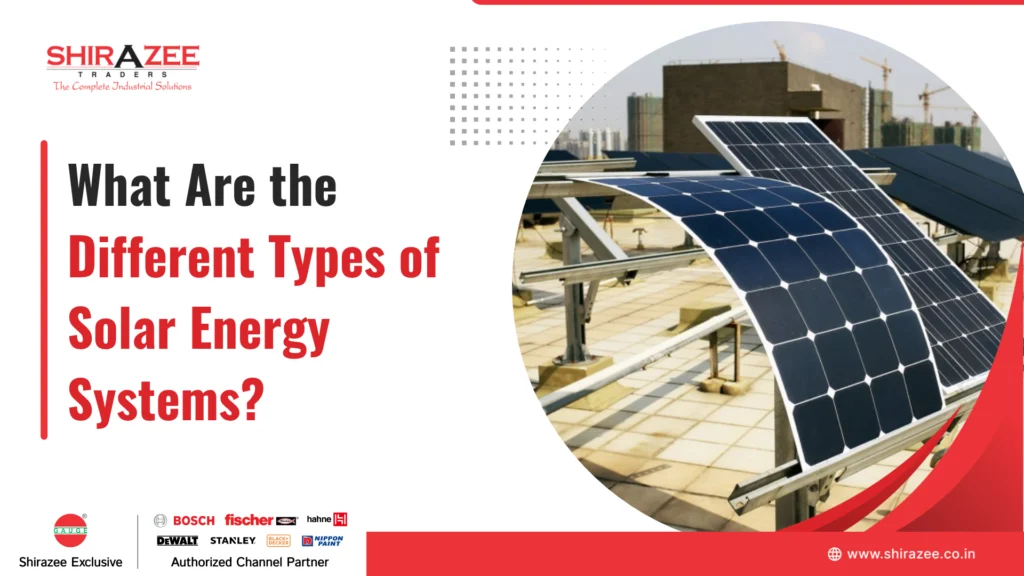
On Grid, Off Grid or Hybrid and Choosing the Setup That Fits Your Load
Grid Tied Systems for Daytime Loads
A grid tied system connects to the utility supply and sends surplus power back through a net meter. It carries no batteries, so it costs less and needs less upkeep. Rohan’s plant runs mostly day shifts, which makes this the natural fit. His roof generates when his load peaks and the grid covers the evenings.
Off Grid Systems for Sites Without Reliable Supply
Off grid systems work on their own and store energy in batteries. Rakesh once used one at a highway site office where the nearest dependable connection sat kilometres away. The batteries, however, add cost and need replacing during the system’s life.
Hybrid Systems When Outages Cost Money
Hybrid systems stay connected to the grid and keep a battery bank for backup if a single power cut can spoil a production batch that backup often justifies the extra spend. You pay extra for the extra security.
Home or Factory, the Scale Changes the Job
A rooftop solar installation on a home and a commercial solar installation on a factory follow the same principles but play out very differently. Commercial projects involve larger loads, industrial roofs, three phase connections and more detailed approvals. Residential systems are smaller and eligible households can claim central subsidy under PM Surya Ghar. Which side of that line does your project fall on? Answer that before you request a single quote.
Inside the System and the Parts That Do the Heavy Lifting
Once Rohan settled on a grid tied setup, Rakesh walked him through what would actually go on the roof.
Solar Modules
The panels turn sunlight into DC power. Module choice affects output per square foot and how well the system copes with a Pune summer, so ask for the datasheet and check temperature performance, not just the wattage.
Solar Inverters
Solar inverters convert that DC power into the AC your machines and the grid use. They work through every daylight hour and usually need attention long before the panels do so give the inverter the same scrutiny you give the modules.
Solar Mounting Structures
This is where Rakesh dug in his heels. One quote proposed a thin, lightly galvanised frame on a metal roof that faces strong premonsoon winds. Solar mounting structures hold the entire investment in place for the life of the system, so they must suit the roof type, resist corrosion and carry wind loads with a margin to spare. Rakesh asked for a heavier section and proper fixing into the purlins. A cheap structure saves money once and costs money every monsoon after.
Balance of System
Cabling, DC and AC protection devices, earthing, lightning protection, the net meter and a monitoring system complete the setup they rarely appear in brochures yet they decide how safe and dependable the system stays.
Choosing an Installer You Will Still Trust in Year Ten
Three quotes later, Rohan faced the harder question of who should actually do the work.
Start with proof. Ask each provider for completed sites you can visit, ideally on roofs like yours, and talk to the owners. An installer who has handled industrial metal roofs will spot problems that a residential specialist might miss.
Next, ask for a real design. A credible installer shows you the shadow analysis, the layout and an expected generation figure. If a quote mentions only a price per kW and skips the generation estimate treat that as a warning sign.
Then read the warranty documents line by line. Modules, inverters and workmanship usually carry separate warranties with different terms and you want all three in writing. Finally, ask what happens after commissioning. Who monitors the system, how fast do they respond to a fault and do they offer an annual maintenance contract?
Where the Money Actually Goes
Those quotes differed widely, so Rakesh broke down what shapes the cost of solar installation services.
- System size. A bigger system costs more overall, but the right size comes from your real load, not from roof area alone.
- Component quality. Module and inverter brands, efficiency and warranty terms all move the price.
- Roof type. RCC roofs, metal sheets and ground mounts each need different structures and fixing methods.
- Site access and cable runs. Height, difficult access and long distances to the main panel add labour and material.
- Approvals and net metering. Documentation and utility processes take time and carry their own costs.
- Subsidy eligibility. Residential households can claim central subsidy under PM Surya Ghar at ₹30,000 per kW up to 2 kW and ₹18,000 per kW for additional capacity up to 3 kW capped at ₹78,000, confirm current eligibility on the official portal before you count on it.
The lesson for Rohan was simple. The cheapest quote cut corners on the structure and offered no generation estimate. Over the life of the system it would probably have cost him the most.
Small Habits That Keep the Panels Earning
Solar systems have no moving parts, yet a few simple habits protect the output Rohan paid for.
- Clean on a schedule. Dust settles fast in Maharashtra’s dry months. A researcher at IIT Bombay’s National Centre for Photovoltaic Research and Education found that panels in Mumbai cleaned weekly lost about 1% of yearly energy to dust, while monthly cleaning pushed that loss to almost 4%.
- Check the monitoring app every week. A sudden dip usually points to an inverter fault, a tripped breaker or new shading.
- Inspect after every monsoon. Look for rust on the structure, loose fasteners and water pooling around mounting points.
- Watch for new shade. A growing tree, a new water tank or construction next door can quietly cut output.
- Book an annual electrical check. Earthing, connections and protection devices need a qualified eye once a year.
Three mistakes deserve a special mention. Avoid choosing on price per watt alone, sizing only for today’s load when you plan to expand and installing on a roof that needs waterproofing repairs first. Taking panels down later costs far more than fixing the roof now.
The Roof Was Never the Hard Part
When the next few bills arrive Rohan notices the difference before he even reaches the total. The roof that sat empty for years now runs a system sized around his actual load anchored to a structure designed for local winds and monitored through an app he opens over his morning tea. Good panels played their part, yet the real gains came from careful planning, sound components and an installation team that knew its job.
If solar is on your list for the coming year, start with a proper site assessment before you collect quotes. After all, what might your own roof reveal if someone took the time to study it properly?
Frequently Asked Questions
How much does solar installation cost?
There is no single price, because the cost depends on system size, component quality, roof type, site access and the approvals your project needs. A factory roof with long cable runs and difficult access needs more material and labour than a simple residential roof eligible households can claim a central subsidy under PM Surya Ghar at ₹30,000 per kW up to 2 kW and ₹18,000 per kW for additional capacity up to 3 kW capped at ₹78,000. Ask every installer for an itemised quote with an expected generation figure so you can compare value rather than just the headline price.
What is the difference between residential and commercial solar installation?
The principles stay the same, but the scale changes the job, a rooftop solar installation on a home is sized around household use and eligible households can claim a central subsidy. A commercial solar installation serves much larger daytime loads, often on industrial metal roofs, with three phase connections and more detailed approvals. That means heavier structures, careful load studies and close coordination with the site's electrical team, so the system fits the way the business actually runs.
How do I choose a reliable solar installation company?
Start with proof. Visit sites the company has completed, ideally on roofs like yours and ask the owners how their systems perform today. Then ask for a shadow analysis, a system layout and an expected generation figure, along with how they arrived at it. Compare the separate warranties on modules, inverters and workmanship and get all three in writing. Finally, confirm who handles monitoring and maintenance after commissioning and how quickly they respond to a fault. A dependable provider of solar installation services answers these questions clearly and without hesitation.