
It is 4 pm on a commercial fit-out site in Pune, Rakesh the site contractor has a door frame that refuses to sit flush, a row of conduit clamp holes still to drill and a stack of MS box sections waiting to become a mezzanine railing, three jobs, three materials, one shrinking evening. What he picks up next decides whether his crew leaves at 5:30 or at 9. These types of situations are common on project sites, but they can be avoided; you must be wondering how? Let us dive deep into it
The Evening Rakesh Lost to the Wrong Machine
Rakesh started with the door frame. He borrowed a hand plane from the carpenter’s kit and spent forty minutes shaving the edge, only to find it still out of square when the shutter went in. The conduit clamps came next. The light household drill he had on hand wandered off its mark on the first hole and grew hot by the sixth. The MS sections went to an angle grinder and every cut came out a few degrees different from the last, so the railing joints needed extra filler and welding.
Rohan, the project manager, saw the full cost the next morning. The crew had worked overtime, two railing pieces had to be recut and the client had walked past a half-finished frame during a site visit. Nobody on that site lacked skill. They lacked the right machine for each job and that gap showed up in the schedule, the budget and the client’s confidence.
Why Bosch Power Tools Earn Their Place on Indian Sites
Most evenings like Rakesh’s trace back to tools bought for convenience rather than purpose. The Bosch Professional range, the blue line most contractors recognise, works the other way round. It groups machines by material and task so dedicated woodworking tools for timber sit apart from the drills and saws built for masonry and steel. That structure makes Bosch power tools easier to match to a job, because each spec sheet tells you plainly what the machine is built to handle.
Buying habits are shifting as well, now more contractors and procurement heads check published specifications before placing an order, rather than going by brand name or price alone, this shift was needed because they now understand the importance of genuine tools. On interior and fit out jobs, compact corded professional drilling machines earn their keep because one person can work with them on a ladder or inside a service shaft. Safety expectations have risen too, particularly around loud cutting tools used on steel sections. In the United States, OSHA caps noise exposure at 90 dBA averaged over an eight-hour working day and sets an 85 dBA action level that requires a hearing conservation programme. Indian sites work under their own regulations but the lesson travels well, a loud tool needs a plan for the person holding it.
One more practical point. Warranty support and genuine spare parts only work when the machine itself is genuine, so where you buy matters as much as what you buy.
So which three machines would have saved Rakesh his evening?
Three Machines, Three Jobs, One Buying Logic
The Bosch Planer Machine That Squares Up Timber in Minutes
A Bosch planer machine is a handheld electric planer that shaves, levels and rebates timber far faster and more evenly than a hand plane. Bosch makes planers for different duty levels, but the Bosch GHO 10-82 is the one site carpenters reach for during fitting work. It runs a 710 W motor at a no-load speed of 16,500 rpm, planes an 82 mm wide strip and lets you set the cut anywhere from 0 to 1 mm per pass. The rebating depth adjusts from 0 to 9 mm, which is exactly what a door or window frame needs when it has to step neatly into its opening. At 2.5 kg, it stays comfortable in one hand through a long day.
The technique is simple. Set a shallow depth, plane with the grain, check the fit and repeat. With the GHO 10-82, Rakesh would have trimmed the binding frame in a few controlled passes, setting the planer down on its parking rest between cuts to protect the blade and the timber. The HSS blade can also be resharpened, which keeps running costs down for busy carpentry crews.
The Bosch Drill Machine GSB 450 for Everyday Holes in Wood, Metal and Masonry
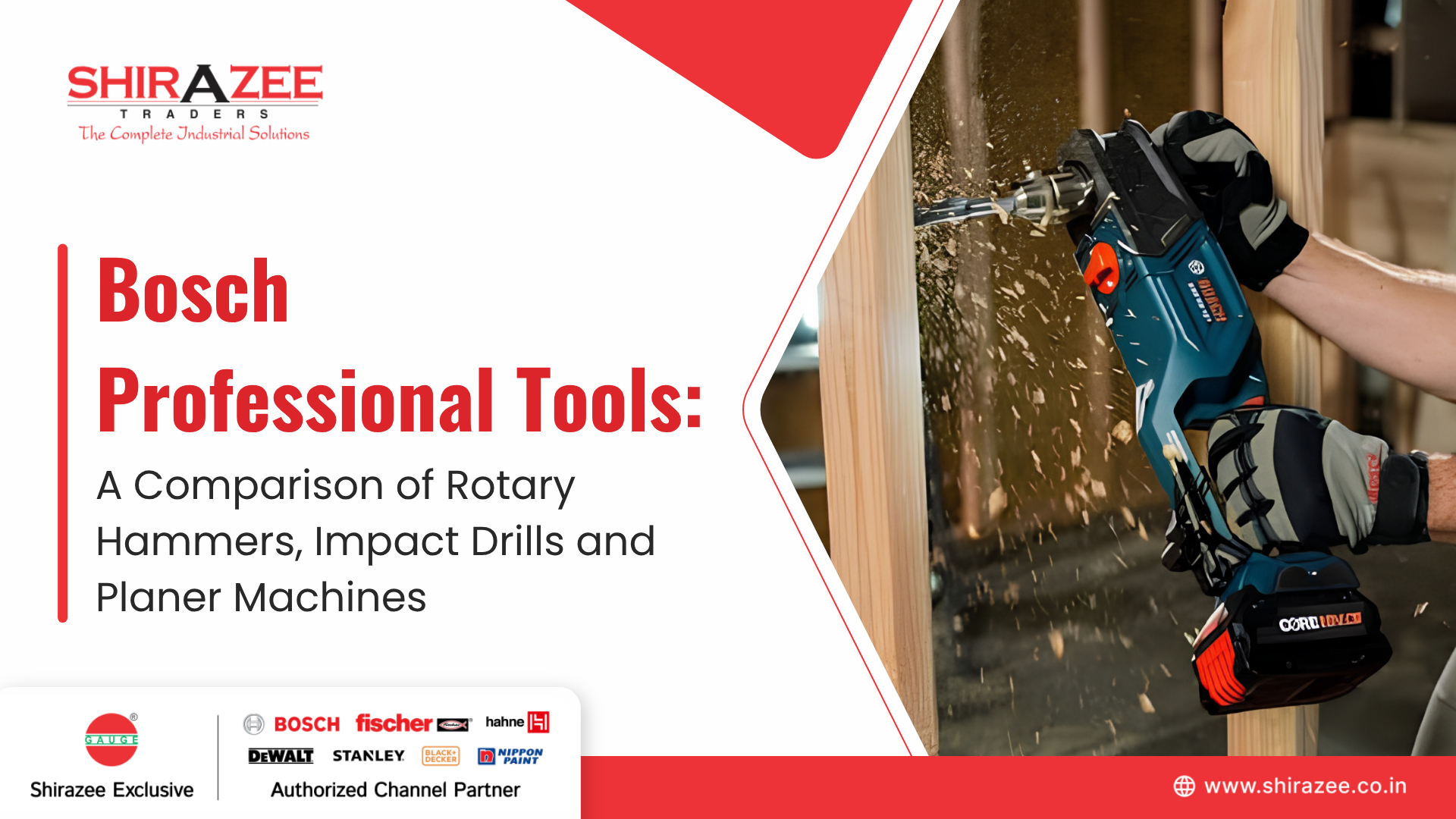
The conduit clamps needed a different answer. The Bosch drill machine GSB 450 is a compact corded impact drill with a keyed chuck that holds bits from 1.5 to 10 mm. It has a rated input of 450 W, a power output of 250 W, a no-load speed of 2,600 rpm and an impact rate of 25,700 blows per minute. On a fit-out job, though, the number that matters most is its weight of 1.5 kg. Drilling overhead or inside a cramped shaft gets far less tiring with a tool that light.
Run it in rotation mode for wood and steel, switch to impact mode for brick and light masonry, and use reverse to back out a stuck bit or screw. With the GSB 450, Rakesh’s clamp holes would have gone in clean and on the mark, with no strained motor.
It has limits, and knowing them saves money. If your crew drills repeated large holes into RCC slabs or beams, an impact drill is the wrong buy and a rotary hammer is the right one. The FAQs below cover that difference.
The Bosch Chopsaw for Straight, Repeatable Metal Cuts
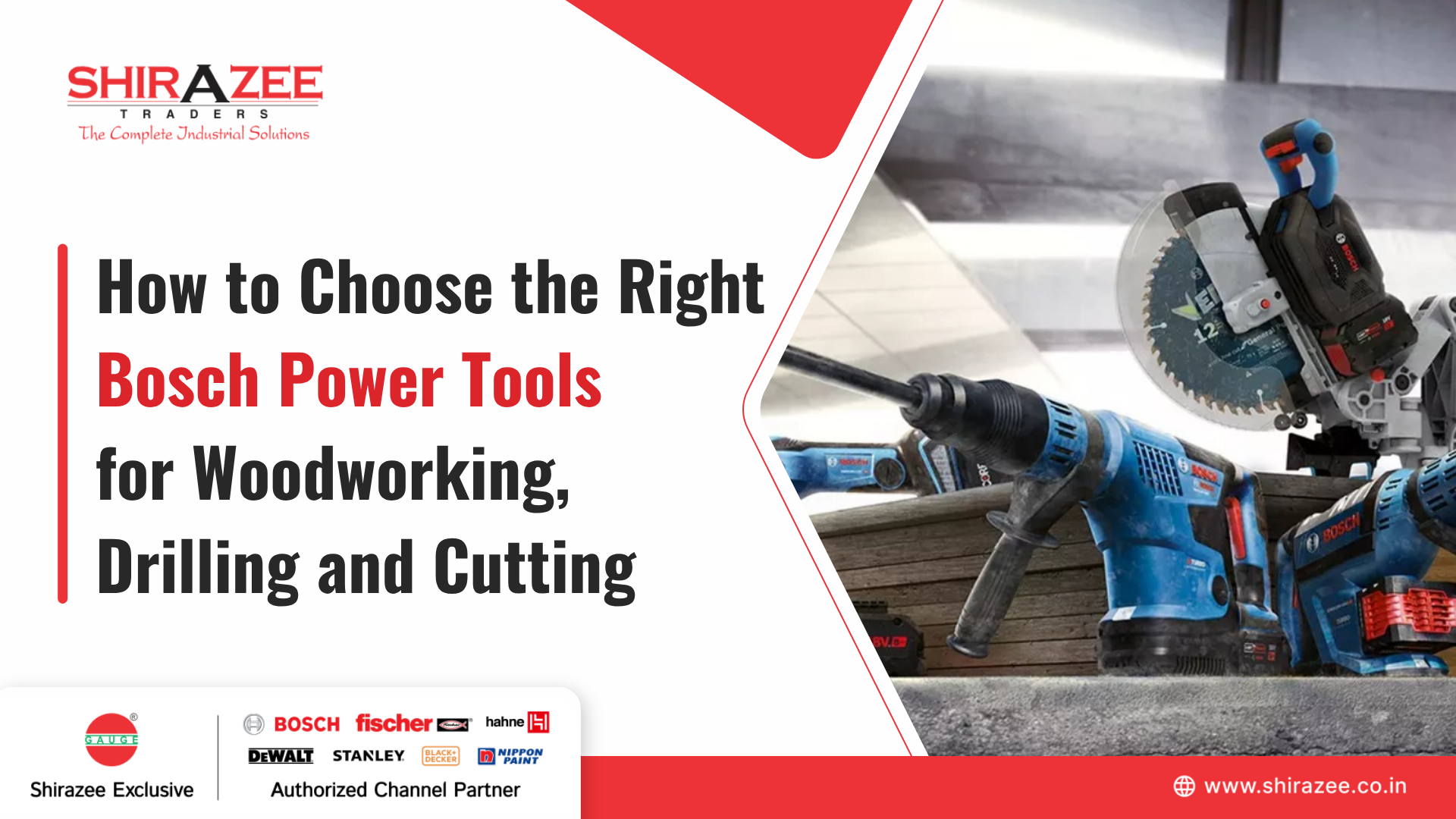
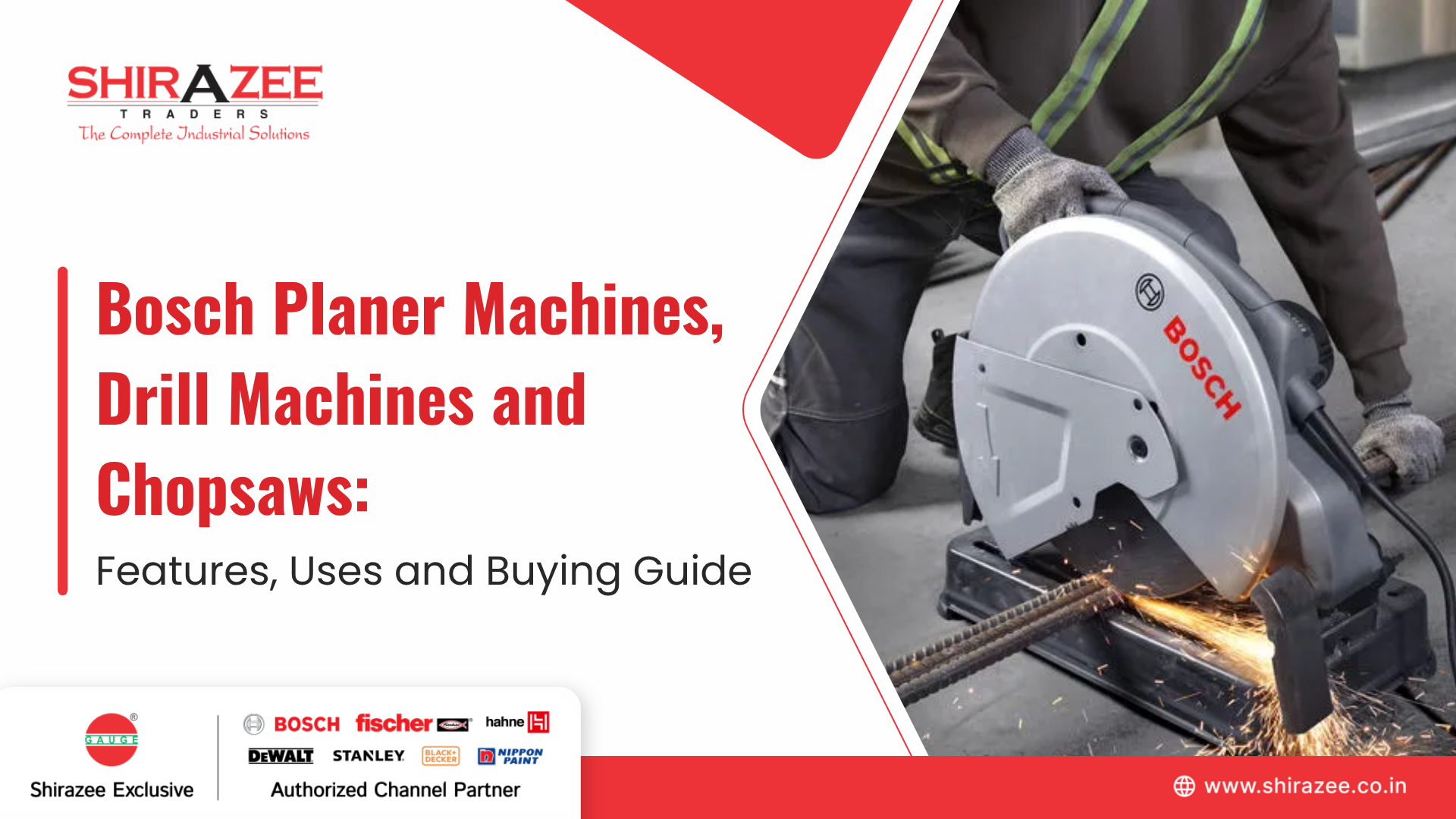
The railing sections were the costliest mistake of the day, because an angle grinder struggles to repeat the same cut twice. A Bosch chopsaw solves that with a pivoting head, a clamp and a fence. The GCO 220, for example, runs a 355 mm abrasive disc on a 2,200 W motor at 3,800 rpm. At a straight 0° cut it takes rectangular sections up to 100 x 196 mm, square sections up to 119 x 119 mm and L-profiles up to 130 x 130 mm, and it also mitres at 45°. At 15 kg, one person can still move it around the site.
Clamp the section, confirm the disc suits the material, let it reach full speed and feed down steadily. With a chop saw on site, Rakesh’s crew could have cut all thirty railing pieces to identical lengths with square ends in one session and the welder would have had clean joints to work with.
Matching the Tool to the Project Before You Spend
So how do you stop Rakesh’s evening from playing out on your own site? These days, Rohan won’t sign off on a tool purchase until he has answers to three questions. What material are we cutting or drilling? How often will this job come up? Who will run the machine, and where? The answers point the way quickly. A carpentry heavy interior package makes a strong case for a planer. A crew fixing services into brick walls is better served by a light impact drill. A fabrication or railing package needs a chop saw. Once the material and the job are clear, the right model rarely takes long to find.
Spec Sheet Details That Deserve a Second Look
Once you know which machine you need, the spec sheet tells you whether a particular model fits your work. A few details deserve more attention than they usually get.
- Rated input and power output are different numbers, the GSB 450 draws 450 W but delivers 250 W of output so compare like with like when you weigh two drills.
- Capacity limits define the job, check planing width and depth on a planer, chuck range on a drill, and cutting capacity at both 0° and 45° on a chop saw against your heaviest section.
- Weight decides fatigue, overhead and all-day work punish heavy tools, and tired operators make costly mistakes.
- Noise needs a plan, chop saws and planers are loud machines, so budget for hearing protection alongside the tool itself.
The common buying mistakes follow a pattern. Crews buy an impact drill for work that needs a rotary hammer, fit discs or blades not rated for the material or pick up non genuine units that arrive without valid warranty support. Each one looks like a saving on the purchase order and turns into a cost on site.
Getting the Right Bosch Tool into Your Crew’s Hands
Rakesh’s evening did not go wrong because of effort or skill. It went wrong the moment someone picked up a machine built for a different job. A planer for the frame, an impact drill for the clamps and a chop saw for the railing would have had his crew packing up by 5:30, with nothing to redo the next morning.
The simplest safeguard is to buy from an authorised dealer who asks about your work before quoting a price. If you are planning tools for an upcoming project, share the scope with us. We will help you match the right planer, drill or chop saw to the job, so your crew spends its evenings at home rather than on rework.
Questions Contractors Ask Before They Buy
Which Bosch planer machine is suitable for woodworking?
For site carpentry and fitting work, the Bosch planer machine most crews rely on is the GHO 10-82. Its 82 mm planing width, 0 to 1 mm cut depth and 0 to 9 mm rebating depth handle door frames, window frames, shutters and general trimming. At 2.5 kg it stays easy to control and the resharpenable HSS blade keeps running costs down.
What is the difference between a Bosch drill machine and a rotary hammer?
Both are professional drilling machines, but they work the material differently. An impact drill such as the Bosch drill machine GSB 450 adds a hammering action to rotation, which suits wood, metal, brick and light masonry. A rotary hammer such as the GBH 2-26 DRE delivers 2.7 joules of impact energy through an SDS plus tool holder and can stop rotation for light chiselling. For regular drilling into RCC, the rotary hammer is the better investment.
How do I choose the right Bosch chopsaw?
Compare the sections you cut most often against the saw's capacity at 0° and 45°. The GCO 220, for instance, takes rectangular sections up to 100 x 196 mm at a straight cut. Check that the right discs for your material are easy to source and consider portability if a Bosch chop saw will move between sites often. Finally, confirm current availability with an authorised supplier.