
A rough weld, an uneven metal surface, or a component that does not meet the required dimensions can interrupt an entire production process. In many workshops, the quality of the final result depends on how accurately the material is cut, shaped, sharpened and finished.
This is where Grinding Machines play an important role. From portable tools used on construction sites to automated machines used in precision manufacturing each model serves a specific purpose. Understanding these differences helps businesses improve output, control finishing quality and choose equipment that fits the actual job.
How Grinding Machines Support Better Industrial Work
A Grinding Machine removes material from a workpiece with the help of a rotating abrasive wheel, disc or belt. The abrasive surface contains many small grains that act like cutting points. As the wheel rotates, these grains gradually remove excess material and improve the shape or finish of the workpiece.
Grinding may appear simple, but its role goes far beyond smoothing a surface. It can remove burrs after cutting, clean welding joints, sharpen tools, prepare surfaces for coating and bring components closer to their required dimensions.
The amount of material removed depends on the machine, wheel type, speed, pressure and material being processed. Heavy grinding can remove larger amounts of metal, while precision grinding focuses on very small adjustments and controlled finishes.
This difference is important. A fabricator removing a weld seam does not need the same setup as a manufacturer finishing a bearing surface. The result may depend on choosing the right machine before the work even begins.
A Closer Look at the Main Grinding Machine Types
Modern Industrial Grinding Machines include portable, stationary, manually operated, and computer controlled options. Each type offers a different balance of mobility, power, control, and accuracy.
Angle grinders for flexible site work
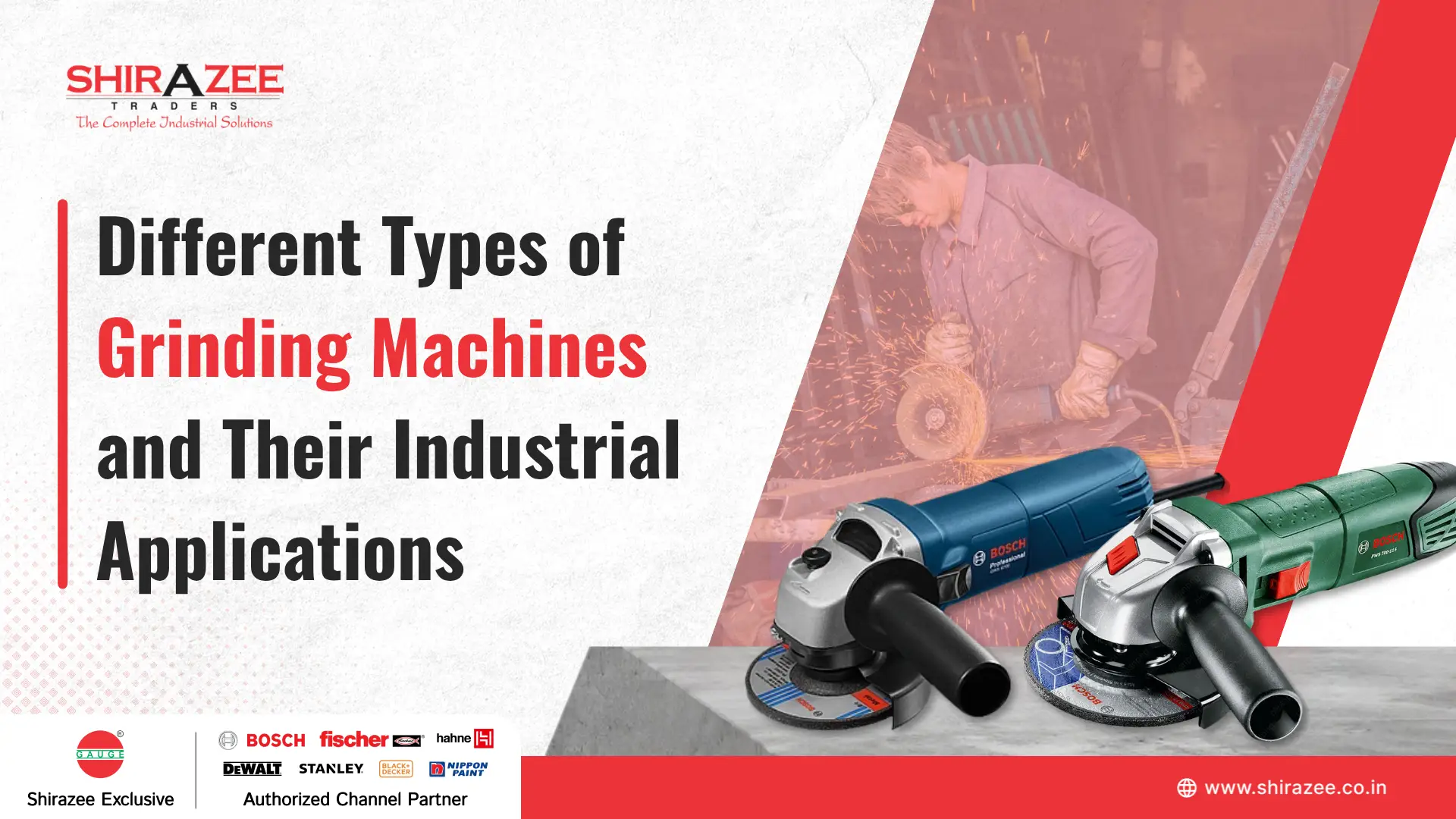
An Angle Grinding Machine is a handheld power tool commonly used for cutting, grinding, sanding, polishing and surface preparation. Its compact design makes it useful when the workpiece is too large or fixed in place.
Fabricators often use angle grinders to remove weld seams, clean rust, prepare metal edges, and cut pipes or reinforcement bars. On construction sites, the same type of tool may be used for concrete, stone, masonry and structural metal, depending on the accessory fitted.
Its flexibility is a major benefit, but the disc must match the intended task. A cutting disc should not be used for side grinding and a metal grinding wheel may not be suitable for concrete. Operators must also check that the wheel’s rated speed is compatible with the machine.
Bench grinders for controlled workshop tasks
A Bench Grinding Machine is generally fixed to a bench or stand and fitted with a grinding wheel on each side. One wheel may be used for coarse material removal, while the other may provide a finer finish.
Bench grinders are commonly used for sharpening drill bits, removing burrs, reshaping small parts and maintaining workshop tools. Because the machine stays in one position, the operator can guide smaller components with greater control.
They are especially useful in fabrication shops, repair centres, maintenance departments, and tool rooms where sharpening and basic metal preparation are regular activities.
Surface grinders for flat and consistent finishes
A Surface Grinding Machine is designed to create smooth, flat, and accurately finished surfaces. The workpiece is usually secured on a table while a rotating abrasive wheel passes across it.
This process can help control flatness, parallelism, surface texture, and component thickness. These qualities become important when parts must fit together correctly or form part of an assembly.
Surface grinders are widely used for metal plates, machine bases, dies, moulds, tool room components and engineering parts. They offer more control than handheld tools and can produce consistent results across the surface of a workpiece.
Precision grinders for demanding tolerances
A Precision Grinding Machine is used when dimensional accuracy and surface quality require tighter control. Instead of focusing only on material removal, the process carefully manages the final size, shape and finish of the component.
Precision grinding includes processes such as cylindrical grinding, internal grinding, centreless grinding, and tool grinding. These methods may be used to finish shafts, bearings, gears, cutting tools and automotive components.
The current ISO 16089 standard covers safety requirements and risk reduction measures for different groups of stationary grinding machines used primarily to shape metal. It includes manually controlled machines as well as machines with powered or numerically controlled axes.
CNC grinders for repeatable production
A CNC Grinding Machine uses computer instructions to control movements such as wheel position, feed rate, depth, and grinding cycles.
Once the machine is programmed and correctly set up, it can repeat the same process across multiple components. This makes CNC grinding useful for high volume production and parts with complex profiles.
Automotive, aerospace, tool manufacturing, and precision engineering businesses often use CNC grinding when consistency is difficult to maintain through manual operation alone. It also reduces variation between parts, although skilled setup, inspection and process monitoring remain essential.
Where Grinding Machines Are Used Across Industries
The value of grinding becomes clearer when we look at its role in day to day industrial work. These machines support several stages of production, from initial fabrication to final inspection.
Metal fabrication and welding
Fabrication teams use grinders to clean cut edges, remove weld beads, smooth joints, eliminate burrs, and prepare metal for painting or coating. Portable grinders are useful when working on gates, frames, tanks, pipes and structural assemblies.
Automotive and engineering production
Automotive manufacturers depend on grinding for components such as shafts, bearings, gears, engine parts and transmission elements. A controlled finish can affect how smoothly components move, fit and perform.
Construction and infrastructure
Construction teams use grinders for reinforcement bars, concrete surfaces, stone, masonry and structural metal. The choice of disc and dust control method becomes particularly important during concrete grinding.
NIOSH explains that concrete, mortar, granite, sand, soil, and artificial stone can contain crystalline silica. Fine particles released during grinding can become airborne and travel deep into the lungs.
A NIOSH study also found that tested grinder and shroud combinations reduced dust exposure by at least 90 % when grinding concrete. This shows why suitable dust extraction and shrouds should be treated as practical safety measures, not optional accessories.
Tool and die manufacturing
Tool rooms use Precision Grinding Machines to produce and maintain dies, punches, moulds, cutting tools and other accurately shaped parts. A controlled grinding process helps achieve the surface and dimensional requirements needed for repeated production.
Maintenance and repair
Grinding is equally valuable after equipment enters service. Maintenance teams use grinders to remove corrosion, restore damaged surfaces, sharpen tools, clean components and prepare parts for repair.
In other words, grinding supports both production and equipment life. The next question is what features help a machine perform these tasks reliably.
Features That Affect Grinding Performance
Choosing a grinder based only on motor power can lead to disappointing results. Several connected features determine how well the equipment will perform.
Power and speed
Higher power may help the machine maintain speed under load, especially during demanding material removal. However, more power is not automatically better for every task.
Variable speed can be useful when working with different materials and accessories. Polishing, sanding, cutting and heavy grinding may each require a different operating range.
Wheel and disc compatibility
Check the disc diameter, bore size, spindle thread, abrasive material, and maximum rated speed. The accessory must suit both the machine and the workpiece.
A disc that does not match the task can wear quickly, damage the material or create a serious safety risk.
Accuracy and movement control
For a Surface Grinding Machine, precision grinder, or CNC system, buyers should review spindle stability, table movement, feed control, repeatability and positioning accuracy.
These features directly affect the final dimensions and surface quality.
Operator comfort
Weight, grip design, balance, vibration and switch placement matter during extended use. A tool that is difficult to control can increase fatigue and reduce accuracy.
Safety systems
Useful features may include restart protection, soft start, braking, overload protection, vibration control, and kickback protection. Protective guards should also be easy to position without interfering with the task.
Choosing a Machine That Matches the Job
The best Grinding Machine is not always the most powerful or advanced option. It is the machine that matches the application.
Start with the material. Are you working with mild steel, stainless steel, cast iron, concrete, stone or another surface?
Next, define the required result. Do you need to cut, sharpen, polish, remove a weld, create a flat surface or achieve a precise dimension?
The workpiece size also matters. A portable grinder may be practical for a large fabricated structure, while a fixed machine gives better control over smaller parts.
Production volume should guide the decision too. A manual machine may suit repair work and short production runs. A CNC Grinding Machine may be more suitable when the same process must be repeated across hundreds or thousands of parts.
Finally, check the available accessories, service support, spare parts, safety features and product authenticity. A reliable machine still needs the correct wheel, proper setup and regular maintenance to perform well.
Safer Operation and Smarter Maintenance
Grinding wheels operate at high speedso small mistakes can have serious consequences. Safe work begins before the machine is switched on.
Inspect the wheel or disc for visible damage. Confirm that its speed rating matches or exceeds the machine’s operating speed. Keep the correct guard fitted and secure the workpiece before starting.
OSHA guidance states that abrasive wheels should generally be used on machines fitted with safety guards. It also requires wheel speed compatibility and recommends visual inspection and ring testing for applicable wheels before mounting.
For applicable bench grinders, OSHA states that the work rest should remain within 1/8 inch, or 0.3175 centimetres, of the wheel. The upper tongue guard should remain within 1/4 inch, or 0.635 centimetres. These limits help reduce the chance of a workpiece becoming trapped between the wheel and the rest.
Operators should also wear suitable eye, face, hearing, hand and respiratory protection based on the task. Sparks must be directed away from flammable materials and nearby workers.
Maintenance is equally practical. Keep ventilation openings clean, inspect cables and switches, check guards, store wheels carefully, and replace damaged accessories immediately. Unusual noise, vibration, heat, or loss of power should never be ignored.
Why Businesses Choose Bosch Grinding Solutions
A Bosch Grinding Machine gives industrial users access to a broad range of power levels, disc sizes, and operating features. This helps businesses select a tool according to the scale of work rather than relying on a single model for every application.
For example, Bosch lists the GWS 600 with a rated input of 670 W, a no load speed of 11,000 rpm, a 100 mm disc diameter, and a listed weight of 1.5 kg. Larger Bosch options include models with 180 mm and 230 mm discs and rated power of 2,200 W, showing how specifications vary across applications.
Shirazee Traders helps contractors, fabricators, maintenance teams, and manufacturing units choose genuine Bosch Professional tools based on the material, workload, disc size, operating conditions and required safety features.
As an official Bosch Channel Partner, we focus on more than product supply. We help you understand which tool and accessory combination fits the work, because the right selection can reduce downtime, improve handling and support more consistent results.
A Practical Decision for Better Results
Every grinding machine serves a different purpose. An angle grinder provides mobility, a bench grinder supports sharpening and workshop preparation and a surface grinder produces controlled flat finishes. Precision and CNC systems serve applications where accuracy and repeatability carry greater importance.
Before choosing equipment, review the material, task, workload, accuracy, safety features and accessory compatibility. A thoughtful choice today can make everyday industrial work safer and more efficient.
Need help selecting genuine Bosch grinders and suitable accessories? Contact Shirazee Traders for practical product guidance based on your industrial application.
Frequently Asked Questions
What are grinding machines used for?
Grinding Machines are used for cutting, sharpening, deburring, removing welds, smoothing surfaces, removing excess material, and achieving precise finishes. They are widely used in construction, metal fabrication, automotive, engineering, maintenance, and manufacturing.
How do I choose the right grinding machine?
Choose a Grinding Machine based on the material, type of work, required finish, workpiece size, production volume, power, speed, disc compatibility, and safety features. The machine should match your actual application rather than simply offering higher power.
What safety precautions should I follow when using a grinding machine?
Always inspect the grinding wheel or disc before use, keep the safety guard fitted, secure the workpiece, and use appropriate protective equipment. Make sure the disc is suitable for the task, and its rated speed matches the machine.
Which grinding machine is best for industrial applications?
The best option depends on the application. An Angle Grinding Machine suits portable cutting and fabrication work, while a Surface Grinding Machine is better for flat surfaces. A Precision Grinding Machine or CNC Grinding Machine is suitable when high accuracy and repeatable results are required.