
A site supervisor once described her week like this. Monday morning, she was stripping decades of old paint off a set of iron railings before repainting them. By Wednesday, she was shrinking heat sleeves over a bundle of exposed cables in a control panel. Thursday brought a plastic pipe fitting job that needed careful, even heat to bond properly without warping the fitting. Three completely different tasks, three completely different heat requirements, and only one tool in her kit that could realistically keep up with all of them.
That kind of week is more common than most people expect on a construction or fabrication site. Projects rarely stick to one material or one task for long, and switching between three or four specialised tools just to manage heat related work eats into both time and budget. This is exactly the situation the Bosch Heat Gun GHG 20-60 is built to handle.
Meet the Bosch GHG 20-60
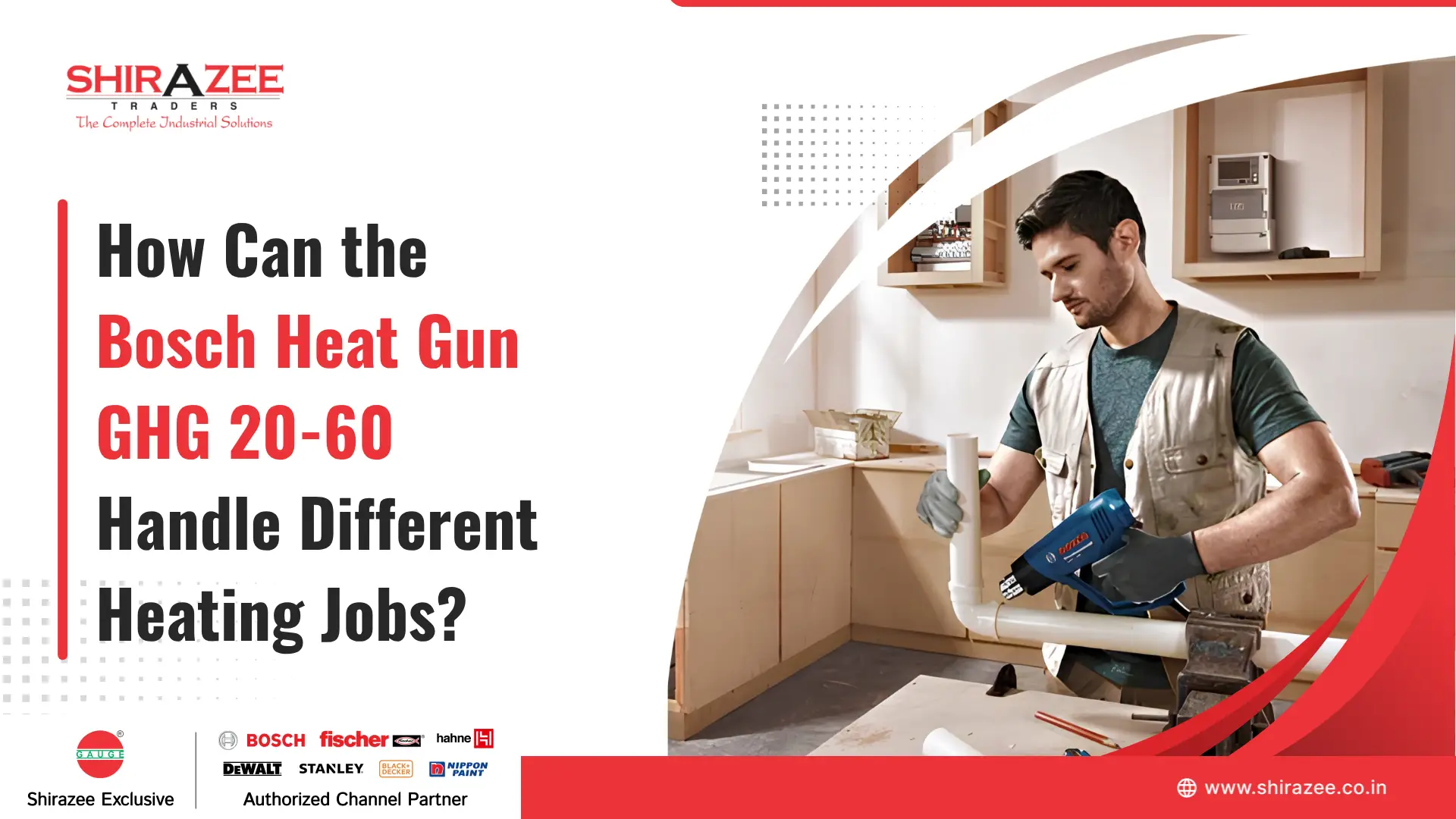
The Bosch GHG 20-60 belongs to a category of tools that rarely gets much attention until the day you actually need one. A Bosch hot air gun does not look complicated on the surface. It is essentially a motor, a heating element, and a nozzle. But the difference between a basic model and a genuine professional heat gun becomes obvious the moment you ask it to do more than one kind of job well.
Think back to that supervisor’s week. A cheaper heat gun might handle the paint stripping reasonably well, since that task mostly just needs raw heat. But ask the same cheap tool to hold a steady, lower temperature for heat shrinking, and it often struggles, either scorching the sleeve or taking far too long to get there. The GHG 20-60 is designed around that exact problem, giving the user enough range and control to move between very different tasks without reaching for a second tool.
What Powers It, and What It Can Actually Do
Underneath the straightforward exterior, the Bosch 2000W heat gun carries a 2,000 watt powerful motor, which is a meaningful amount of power for a handheld tool of this size. That power translates into a working temperature range of 50°C to 630°C, adjustable in nine stages through a simple thumbwheel. Airflow is controlled separately, with two stages ranging from 150 to 500 litres per minute.
None of these numbers matters much sitting on a spec sheet. What matters is what they let a person actually do on site and this is the most important thing. A wide temperature range means the same tool that removes old paint at high heat can also be dialled right back for delicate plastic work later the same day. Two airflow settings mean the operator can slow things down when working close to something heat sensitive or speed things up when covering a larger surface where time matters. And because the tool weighs only 0.6 kilograms it stays manageable through a long day of overhead or repetitive work, which is not something every heat gun can claim.
For a procurement head comparing options, this combination is often the deciding factor, since one unit covering paint work, plastics, and light metalwork replaces the need to budget for two or three separate tools.
One Dial, Many Materials
Here is a question worth asking before picking up any heat gun for a new task. Does the material in front of you need a slow, steady warm-up, or a quick blast of high heat?
This is where the Variable Temperature Heat Gun design of the GHG 20-60 earns its keep. The thumbwheel is not just a basic power switch that turns the heat up or down in a rough sense. Its lowest setting is genuinely useful for cooling down a heated workpiece or drying a freshly stripped section of paint, while the higher stages push toward that 630°C ceiling for tougher removal jobs. Instead of forcing every material through the same blast of heat and hoping for the best, the operator adjusts the tool to match what is actually in front of them.
Going back to the site supervisor’s example, the paint stripping task on those iron railings called for the higher end of the range moved steadily across the surface to avoid scorching the metal underneath. The cable sleeve shrinking a few days later needed something far gentler and more controlled, held closer to the material but at a fraction of the heat. Same tool, same hand a completely different setting dialled in within seconds.
Where the GHG 20-60 Earns Its Keep
This is really where the value of a tool like this becomes clear, because the list of GHG 20-60 heating applications covers a surprising amount of ground for a single handheld unit.
Paint and varnish stripping remains one of the most common uses, and for good reason. High, steady heat softens old coatings enough to scrape them cleanly, without gouging or scorching the surface underneath which matters a great deal when the substrate is worth preserving.
Heat shrinking and paint stripping often get grouped together in product descriptions, but in practice they sit at opposite ends of the temperature dial. Shrinking cable sleeves, protective wrapping or heat shrink tubing needs a controlled, even heat that will not scorch or distort the material which is exactly the kind of precision the lower thumbwheel settings are built for. An electrician working through a panel full of cable joints benefits from being able to trust that setting every single time, rather than guessing.
Plastic welding is another area where this tool holds up well. As a genuine plastic welding heat gun, it can soften and bond plastic components or pipe fittings with enough control to avoid warping the material around the joint. For a contractor working on plastic pipework or fittings, that level of control often makes the difference between a clean, reliable bond and a reject piece that needs redoing.
Soldering and tin plating round out the list, giving procurement teams a single industrial hot air tool that covers paint work, plastics, and light metalwork without needing three separate machines in the toolbox.
Why the Straight Line Design Changes How You Work
A detail that gets overlooked in most spec sheets is the shape of the tool itself. The GHG 20-60 uses a straight, inline design rather than a pistol grip, and that difference shows up the moment the work moves away from a comfortable, eye level surface.
Working at floor level, along a skirting board, or in a tight space under a fixture becomes noticeably easier when the tool sits comfortably in almost any hand position, rather than forcing an awkward wrist angle. Floor layers in particular benefit from this shape, since a large share of their work happens close to the ground where a poorly angled gun becomes tiring within an hour, let alone a full shift. The same benefit applies to anyone working overhead or in a cramped service space, where a pistol grip tool would need to be held at an uncomfortable angle for extended periods.
Staying Safe at High Heat
A tool that reaches 630°C deserves a bit of respect, and the GHG 20-60 is built with that in mind. Keeping the nozzle too close to a workpiece can block airflow around the tip, and a blocked nozzle is one of the more common causes of overheating in heat guns generally, regardless of brand. Giving the airflow room to move, and resting the tool safely on a stable, heat resistant surface between uses rather than setting it down directly on a workbench, goes a long way toward avoiding trouble on site.
The lowest thumbwheel setting also doubles as a practical safety step. Running the tool on this setting for a short period before switching it off entirely lets it cool down gradually rather than leaving a scorching hot nozzle exposed the moment power cuts out. It is a small habit but one that prevents a fair number of avoidable burns and damaged work surfaces.
Getting the Settings Right
So how does someone actually choose the right combination of heat and airflow for the job sitting in front of them?
A reasonable rule of thumb is to start lower than instinct suggests and work upward from there. Paint stripping usually calls for the higher end of the temperature range, run at a steady, even pace across the surface rather than lingering in one spot. Heat shrinking wants a lower, gentler setting paired with the reduced airflow stage, applied evenly rather than held still so the material shrinks uniformly instead of bunching or scorching on one side. Plastic welding sits somewhere in between the two, needing enough heat to soften the material without pushing it toward deformation or discolouration.
Testing on a scrap piece of the same material before committing to the actual workpiece is a habit worth keeping, especially for anyone newer to the tool or working with an unfamiliar material. It costs a minute of extra time and can save an entire finished piece from being ruined.
The Right Heat, Every Time
Whatever the job looks like on a given day, paint removal in the morning plastic welding by afternoon, or a delicate heat shrinking task somewhere in between the value of a tool like the GHG 20-60 comes down to one simple idea. It adapts to the work, rather than forcing the work to fit around its limits.
For contractors, engineers and procurement teams juggling varied heating tasks across a single project that kind of flexibility is worth more than any one feature on a spec sheet. If your team is weighing up a heat gun for mixed applications, it is worth taking a proper look at what this one can cover before settling on something more limited.
FAQs
Can the Bosch GHG 20-60 be used for stripping paint?
Yes. Paint and varnish stripping is one of its core applications. The higher end of the temperature range softens old coatings cleanly for scraping.
Does the Bosch GHG 20-60 have adjustable airflow settings?
Yes. It offers two airflow stages, ranging from 150 to 500 litres per minute, so the operator can slow down for delicate work or speed up for larger surfaces.
Is the Bosch GHG 20-60 suitable for plastic welding and pipe bending?
Yes. Its controlled heat and adjustable settings make it suitable for plastic welding and pipe fitting work, helping avoid warping around the joint.
What safety features prevent the heat gun from overheating?
Keeping airflow clear around the nozzle prevents blockage which is a common cause of overheating. Running the tool on its lowest thumbwheel setting before switching off also lets it cool gradually rather than shutting down while still hot.